ScreenGawk
Why Greg’s Bartender Ballad in Crazy Ex-Girlfriend Isn’t Just a Joke
Prefer ScreenGawk on GoogleSee more of our stories in your results
Greg, the bartender in Crazy Ex-Girlfriend, gets a season-one ballad titled with the question a bartender asks all night. Rachel Bloom, the series co-creator and star, told Emmy magazine in 2017 that “What’ll It Be” works two ways: it is what a bartender says, and it is a metaphor for Greg’s life.
Emmy magazine describes the song’s piano riff as echoing Billy Joel’s “Piano Man” and the number as dramatic rather than a comedic parody. That gives a familiar sound a different job. Here is one way I read the title: someone who spends the evening taking other people’s orders faces a question turned back on him. The order-taking reading is interpretation. Bloom’s stated point concerned craft: finding a song’s title, or thesis statement, taught her a lot.
The pilot began with Bloom and Brosh McKenna
Aline Brosh McKenna found Bloom through online videos in which Bloom played a range of characters. Emmy magazine’s 2018 profile says Brosh McKenna saw that the characters shared something fragile, a quality Brosh McKenna described as “a little bit of a sob in their heart.” Soon after, the two were brainstorming together, retooling one of Brosh McKenna’s film ideas into a television series.
That starting point suggests a default for watching. When a number lands, ask whose it is before asking what genre it borrows. A song in this series can be a gag and still be a character showing what they hope to be taken for.
From a line in the script to a finished song
Brosh McKenna told Emmy magazine that after putting original music in the pilot, the plan was to keep doing it every week. Through the first two seasons, according to the magazine’s 2017 account, episodes had two or three original songs. Brosh McKenna recalled suggesting during a script discussion that a scene could use a song in which the characters say they definitely should not have sex right now. In her telling, half an hour later Bloom and Jack Dolgen had written “We Definitely Should Not Have Sex Right Now.”
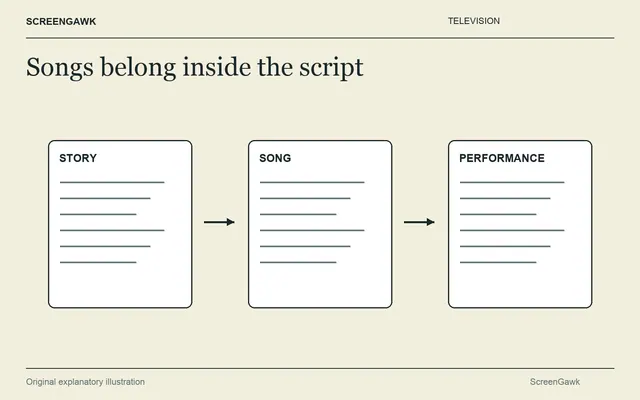
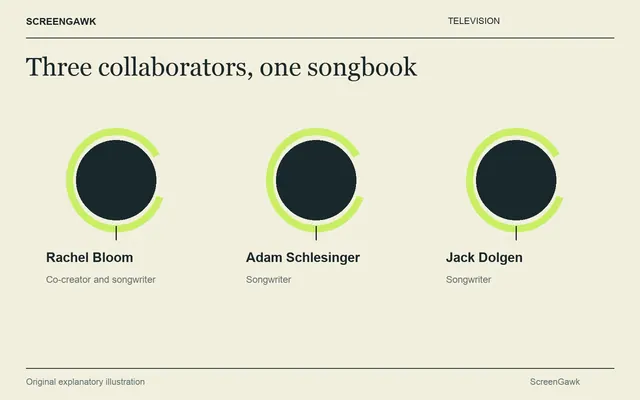
The team behind those songs was Bloom, Adam Schlesinger and Dolgen, with Brosh McKenna contributing ideas and holding songwriting credit on several songs. Planning ahead gave the songwriters room to stockpile material. Bloom put the total at 82 songs across the first two seasons, a figure from 2017 that does not include the rest of the series.
For a viewer, that makes the script a fair place to start. Ask what the scene needed the characters to say, then notice what the song does with it. The choice, if there is one, tends to sit in the gap between the two.
The winds get a verse
In a second-season episode, the Santa Ana winds appear in human form, played by guest star Eric Michael Roy, and recur throughout the story. A song was written to celebrate them. Bloom called it an example of using comedy songs to move the story forward and “a fun way to marry story structure and songwriting.” A weather system gets a verse and a recurring role, which is more attention than most forecasts receive.
That is the easiest kind of number to read for choices, because a song built to move the story has to leave something different behind it. Bloom describes the song’s job, not the plot it moved, so what changes once the winds finish is yours to spot. After the last chord, ask what a character can do that was out of reach before. If the answer is nothing, the number is probably doing other work, such as a joke or a genre exercise, and that is a legitimate use too.
Songs written around the singers
Emmy magazine describes performers as another possible source of inspiration. It reports that Vincent Rodriguez III, who played Josh Chan, brought acrobatics and martial arts into “Angry Mad.” Santino Fontana, who played Greg, had a classic crooner voice that led to the Fred-and-Ginger-inspired dance number “Settle for Me.” The piece also identifies Donna Lynne Champlin, who played Paula, as a Broadway powerhouse. Bloom praised Champlin’s voice rather than naming a song built around it.
A performer’s skill can pass for a character’s boldness. Emmy magazine says “Angry Mad” drew on Rodriguez’s abilities. Whether a showcase also tells a viewer something new about Josh is a separate question. A character can benefit from the pleasure of watching a skilled performer, while the story still has to give the number a reason to happen.
A familiar sound is a clue, not a verdict
Emmy magazine lists the ground the series has covered: show tunes, ’80s power ballads, heavy metal, torch songs, even barbershop quartets. Dolgen says deciding a song’s genre helps inform the comedic angle, and credits Schlesinger and music-production partner Steven Gold with making it possible to write so many songs, across so many genres, so quickly. Schlesinger adds that sometimes the parody target is obvious, and other times a song starts in one place and ends up somewhere else.
The piano riff in “What’ll It Be” makes that distinction useful. A listener could recognize the “Piano Man” reference and still have a question about tone: is recognition preparing a joke, or giving a serious feeling familiar musical clothing? The magazine’s dramatic-versus-parody description favors the latter. Knowing the reference is a beginning. It does not replace considering Greg’s situation.
Nearly ten songs for one goodbye
When Santino Fontana, who played Greg, was leaving the show, the writers scrapped nearly ten songs before Bloom got permission from The CW for Greg to curse, as long as it was bleeped. The result was “It Was a Sh*t Show.” Emmy magazine notes that the uncensored online version had drawn hundreds of thousands of views by 2017. The permission and its condition are part of the song’s production history.
Emmy magazine’s account does not say why the earlier songs failed, so the count measures effort rather than proving the final song was the right goodbye. A viewer can ask what the number lets Greg express and what changes when the writers give a farewell permission to be blunt. The number of discarded attempts cannot answer those questions on its own.
Where the question runs out
The practical objection is time, and the answer is that nobody needs a notebook for a musical comedy. The question takes one number and one scene, and it costs no extra viewing.
Schlesinger recalled that the season-two production number “The Math of Love Triangles” was already completely formed in Bloom’s head before he heard about it. Emmy magazine describes the remaining challenge as finding the comedic hook, since math puns go only so far. I read that distinction as the difference between having a set piece and knowing what makes it funny. A scene can still need work after its central musical idea has arrived.
Bloom also says that unless a song arrived perfect, everyone had input, so a choice in a song passed through several tastes. It is safer to say what the song makes the character do than what any one writer meant.
For one second look, start with “What’ll It Be” and ask what its title lets Greg consider. “Settle for Me” offers a different question about the fit between a performer and a style; the winds song supplies a question about moving the story. Choose whichever question interests you, rather than treating every song as a puzzle with one answer. If the pleasure is already in the music or the performance, a further breakdown may add little to that viewing.