ScreenGawk
How Gromit Found His Voice Without a Talking Mouth
Prefer ScreenGawk on GoogleSee more of our stories in your results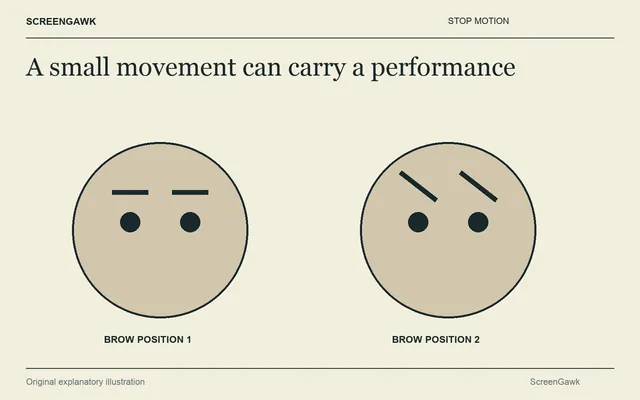
In a January 2025 Bullseye interview transcript, Nick Park recalled finding Gromit's planned mouth impossible to animate on the first shooting day of A Grand Day Out. Moving the brow offered an unplanned alternative. A speaking part would have added another vocal turn beside Wallace. A brow leaves room for a reply of a different kind. The interest, to my mind, is in the exchange: one character can state a plan while another shows a response. Silence gives that response its own space, without requiring it to become a speech.
Aardman identifies Wallace as an inventor and Gromit as his trusted canine companion, and dates their introduction in the 1989 short A Grand Day Out. Their partnership gives an expressive face something to respond to. An inventor's explanation can occupy the dialogue while the companion remains present in the picture. That arrangement gives the audience two characters to follow even when only one of them is talking.
A brow, a blink and the scene around them
Jesse Thorn, the Bullseye host, pointed to Gromit's eyebrows and head tilt as tools for bringing the character to life. Park agreed the design was simple. My reading is that an expressive face also works in time. A lifted brow during a confident announcement might suggest familiar impatience; the same movement after a pause might suggest fresh uncertainty. The final shape could be identical while its relation to the other character's action changed.
Park said Gromit became more intelligent than Wallace, giving the pairing comic contrast. That description puts the pair on different footing without requiring a contest between two speakers. The listener can seem to understand something before the speaker does. In a comic partnership, that gap offers room for anticipation: a viewer may be waiting for a confident figure to catch up with a companion's doubt. Giving the doubt a face keeps it beside the explanation instead of interrupting with another explanation.
Discussing Feathers McGraw in The Wrong Trousers on Bullseye, Park pointed to a blink, a camera move and Julian Nott's music as ways to suggest thought. The small gesture has company. Camera movement can bring it forward, and music can lend it emphasis. To my mind, that is a reason to resist making an eyebrow the complete explanation of a silent performance. A viewer absorbed by the character may experience those choices together rather than separate them into departments. Silence here concerns the character's speech, not an empty soundtrack. A companion's dialogue, an effect or the music can still occupy the moment around an expression. The face belongs to a scene that has other ways to direct attention.
Finding Wallace’s mouth shape and wave
In Park's account of making Wallace, recorded speech came before the animation. That gives a discussion of silent expression a useful companion: the movement of a character who does speak. A voice and a gesture can each draw attention, and their relationship need not amount to illustrating every word. I find it useful to distinguish the shape suggested by a delivery from a movement of the hands. One works at the mouth; the other can spread the performance across the figure.
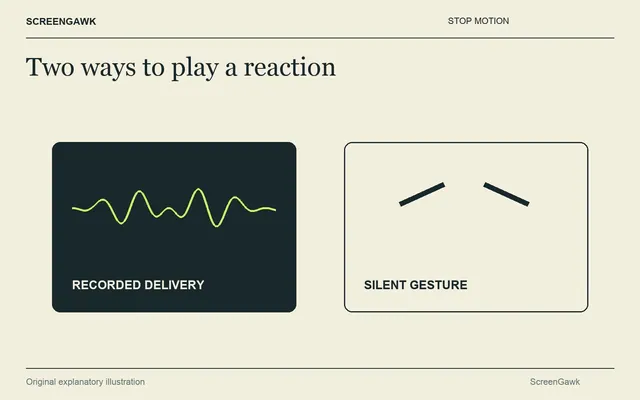
Speaking to Terry Gross in 2000, Park said the voices were recorded first. He recalled Peter Sallis's delivery of one word suggesting a pleasing mouth shape for Wallace.
On Bullseye, Thorn places Wallace and Gromit together in their spaceship when Wallace realizes they forgot the crackers. Park recalls moving a fist in and out while using Sallis's recorded line, and says the studio calls the gesture the Wallace wave. A spoken realization acquired a movement that could accompany it. In my reading, this offers a useful companion to Gromit's silent expression: Wallace's response spreads beyond the mouth into a gesture of the hands.
Lord’s account of a physical take
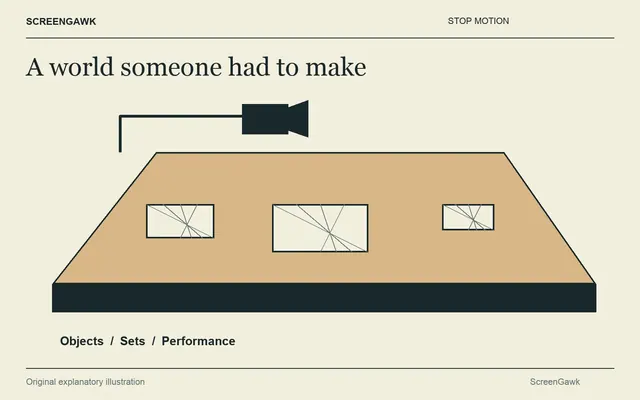
Aardman co-founder Peter Lord, in the 2000 Fresh Air interview rebroadcast in 2005, compared physical stop-motion work with live performance. A puppet sets off across the set, and the animator can guess, approximate and rehearse but cannot know exactly where it ends up. Lord said the studio could not easily revise its physical animation in the way a team could revise computer or conventional cel animation; he described shooting it again. He is discussing a puppet crossing a set, a larger action than a change of expression. In my reading, the comparison makes an apparently casual response interesting as a piece of work. The finished movement may look spontaneous to a viewer who has no reason to consider the separate adjustments that brought it there.
Clay and silicone in Vengeance Most Fowl
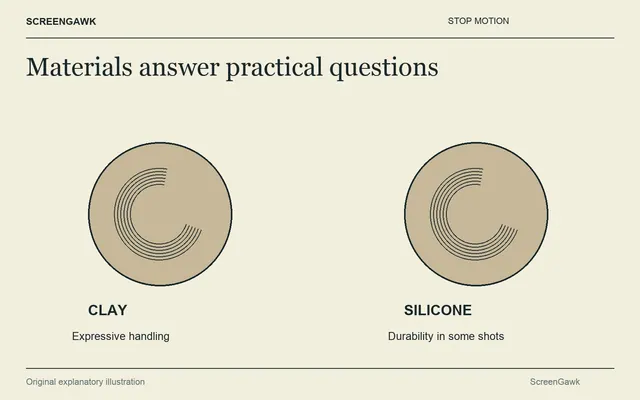
Discussing Vengeance Most Fowl, Park described silicone as useful for wear and time in some shots away from close-ups, while the team often kept clay where expression mattered. Practical material choices and the look of a puppet are related questions, but they do not settle what a response means between two characters. For a viewer, the exchange can remain the starting point: who is doing something, who is responding, and what changes as the response unfolds? The partnership gives the expression a context beyond the physical substance of the figure.
What can an expression mean?
The same gesture can also remain ambiguous. A raised brow could suggest doubt, surprise or recognition, depending on the exchange. A viewer who decides in advance that every silent reaction means disapproval may miss that range. For a rewatch, it is more useful to keep a question open for a few seconds: what happened immediately before the movement, and what does the other figure do afterward? That comparison asks the scene to supply a context instead of making an eyebrow carry the entire explanation. Try keeping the response open until the exchange finishes. An early impression of impatience might change once the other character acts. The interest lies in allowing that small uncertainty to survive long enough to become part of the joke.
If you have seen A Grand Day Out, return to the crackers moment for a second look; save the exercise until after a first viewing if the short is new to you. Make one pass following Wallace's hands against Sallis's delivery. Then give Gromit a separate pass: what does he do during or after the line? Compare what you notice with your first response to Wallace. Does watching the listener change how you read the speaker's confidence, or draw your attention to something else? The two passes give the partnership time to register without asking you to abandon the joke in order to catalogue how it was made.