ScreenGawk
The Tiny Office Linking Fantastic Mr. Fox to Roald Dahl
Prefer ScreenGawk on GoogleSee more of our stories in your results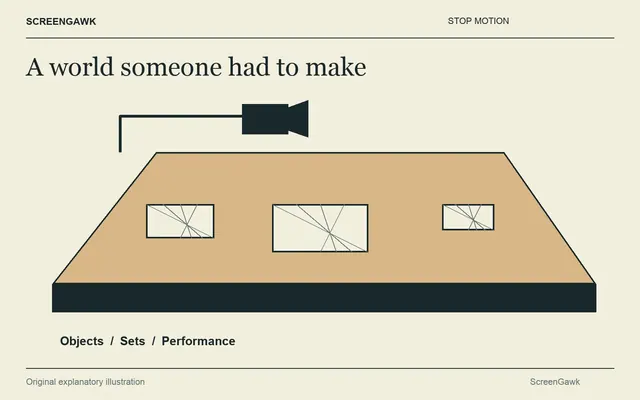
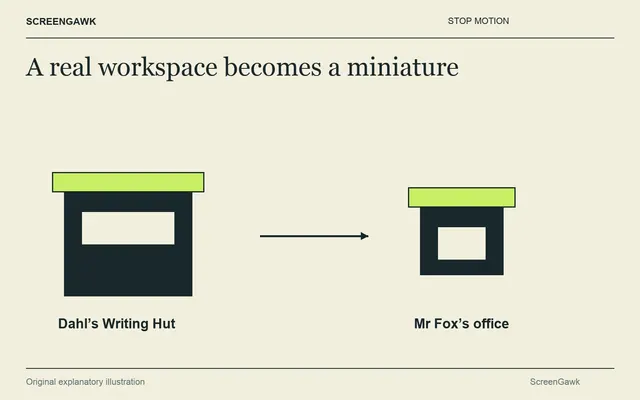
Mr Fox's office in Wes Anderson's Fantastic Mr Fox holds a miniature Toby jug, a miniature pencil sharpener and a miniature armchair. The Roald Dahl Museum says the room is largely based on Dahl's Writing Hut and that the three small pieces were made as versions of Dahl's own. The museum credits Anderson with choosing to make the miniatures.
What craft choice changes how a scene feels? In stop motion, where puppets are posed and photographed frame by frame, nothing appears on screen unless someone builds it and places it. That turns a scene's texture into decisions: what a room holds and where a character stands. Anderson's account touches both, and the Dahl Museum shows how far the film reached back into the author's own materials.
Made on purpose
A BFI programme note published in 2024 reprints Anderson's 2009 interview with Sam Davies for Sight and Sound. Anderson said stop motion means every detail he imagines has to be made. He described specifying how an object looks, down to what is printed across it, and treated that as a chance to add more detail. He also said the format lets him manufacture his own skies, something he had rarely managed in other films.
Davies reports genuine hair on each fox model and skies and clouds that reference Rothko. Davies also notes that a productive day of stop-motion shooting might yield three seconds of footage.
Making every visible object calls for several kinds of work. The credits name MacKinnon & Saunders for puppet fabrication and Nelson Lowry as production designer, alongside environment designers and key animators. The office's furnishings belong to that larger task of making a place for the characters to occupy.
Two huts with different roles
The Roald Dahl Museum's account describes two different buildings. Dahl's widow, Liccy, invited Anderson to stay with the family in Great Missenden while he worked on the screenplay. Davies adds that Noah Baumbach stayed in the house too. Anderson photographed the garden's hairy hut, which his team recreated for the opening at Berk's Squab Farm. That structure is separate from the Writing Hut that inspired Mr Fox's office.
For the office, the museum identifies miniature versions of Dahl's Toby jug, pencil sharpener and armchair. It says the room is largely based on his Writing Hut. Those three named pieces give the connection a particular scale: the recreation reaches from the room down to something a character might pick up or sit in.
Movement a puppet allows
Anderson names a second advantage, and it concerns where characters stand. "Animation allows a certain kind of blocking of scenes that I like," he told Davies. Blocking means planning where performers enter, exit and stand in the frame. With the puppet on a stand, he said, a character could enter sideways or upside down, or exit in the foreground and re-enter deep in the background in one move.
Compare an object in a room with a figure entering it. The object has a shape and a place in the room. An entering figure changes the arrangement. A viewer can ask when the figure becomes visible, whether it crosses an open area or passes behind something, and what remains visible after it stops. Those are questions about blocking, rather than an inventory of objects. Anderson's list of possible sideways and upside-down entrances gives the questions a concrete starting point.
From sketchbook to supermarket
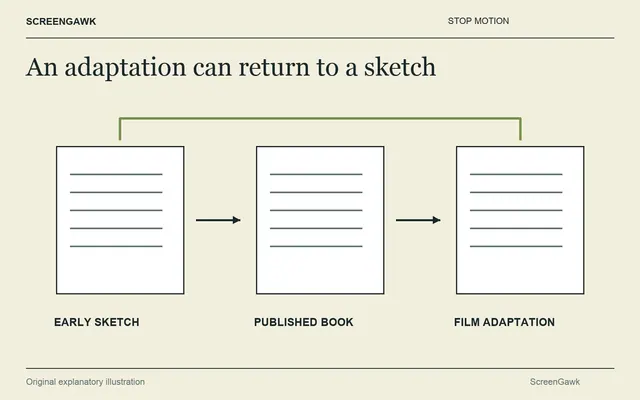
The adaptation has a paper trail that predates the film by decades. The museum says Dahl typed a first draft of the story, cut up the pages and pasted the snippets into blank sketchbooks, then drew around the text to imagine the finished picture book. In those drawings the foxes dig toward the local town and up into the shops, and in one sketch the young foxes push supermarket trolleys in search of "ham, pies and cake."
Publishers were wary of a story about foxes stealing, the museum says, and editor Fabio Coen suggested raids on the wicked farmers' farmyards instead of the supermarket. Dahl rewrote the book, published in autumn 1970 with Donald Chaffin's illustrations. The museum links the film's supermarket ending to the early sketch of foxes stealing from their local shop. Anderson's film also includes raids on the farmers. The sketchbook connection gives the supermarket a history of its own: a discarded idea from Dahl's early work became a setting in the adaptation.
Voices and the author as a fox
Sound was adapted too. Anderson told Davies that he and Baumbach found writing British voices a stunt, so the animals speak with American accents and the humans with British ones, and that animals have no accents of any kind, so nothing real is violated. He also described recording the cast in an enormous range of places, from a New York apartment to a studio in France and a lakeside in Italy.
Anderson gives the title character two sources. He says Mr Fox is inspired by the book and equally based on Dahl himself, and that while writing, he and Baumbach thought of the character as "Roald Dahl as a fox." The museum draws the same line, saying Anderson leans into the autobiographical nature of Mr Fox. Set that beside an office largely based on the Writing Hut and the choices point the same way: a character modelled on a writer, working in a room modelled on that writer's.
When detail doesn't steer the eye
A miniature jug may do little for a viewer who never registers it. Davies also says some touches may go unnoticed. An object's history and its role in a scene are different questions. Learning where it came from does not establish how much attention the staging gives it. A viewer following a moving character could miss a small prop, even when the maker has reproduced it carefully.
Consider the difference between recognising a room and recognising a reference. In a hypothetical room, an armchair beside a work surface could make an office legible before anyone identifies its model. Knowing that the armchair follows Dahl's gives the same furnishing a second interest. The first response concerns the fictional room; the second connects that room to a real person's work. Either can be rewarding, and they need not arrive together. The extra history adds a layer without making recognition a test the audience has to pass.
When Mr Fox's office appears, try following the character first, then giving the nearby furnishings a second look. Which objects register immediately, and which become interesting once you know about Dahl's Writing Hut? That is a small comparison a viewer can make without treating every prop as a hidden clue. The museum's three named miniatures offer a manageable place to begin. Anderson's interest in blocking supplies the other question: how does a figure's position affect what else you notice?