ScreenGawk
How Ben Burtt Built WALL-E’s Voice and Machine Sounds
Prefer ScreenGawk on GoogleSee more of our stories in your results
Disney's production account says WALL-E's compacting noise was a recording of a car being crushed at a dump. A real act of compression supplied the sound for an animated machine. The character's voice began with different material: in the AWN interview, Ben Burtt describes blending a human performance with electronics. One sound can give the robot a physical action while another gives that same figure something like a vocal performance.
A voice built from a person and a circuit
In a question-and-answer published by AWN, Burtt says the WALL-E voice began as a trial using Burtt's own voice, never meant to be the final one. Burtt adds that each audition for director Andrew Stanton ended with Stanton choosing a few elements to keep, and that once a voice worked, starting over with a different human voice looked hard. So the experiment stayed.
Burtt says creating the illusion of a voice is the hardest task, because voices are hard to fool. Early WALL-E versions leaned on motor sounds alone, or on beeps and whistles in the R2-D2 mold. Burtt says the team took pieces from those experiments. Burtt links the expressive vocals to the singing voice in the opening song of the storyboard reel, while allowing that he cannot entirely explain how the character's voice emerged.
Burtt describes the method as a blend. The best way to get a robot voice, Burtt says, is to combine a human element with an electronic one, so the circuit Burtt built starts with Burtt's own voice, analyzes it on a computer and resynthesizes it, which means the sound is broken into parts and rebuilt. EVE's voice, per Burtt, was made in a similar way from recordings of Pixar employee Elissa Knight, which Disney says Burtt processed. Burtt says Knight's recording began as a scratch track, a temporary stand-in used while the work is still in progress, and was kept once the computer process produced a result the team liked.
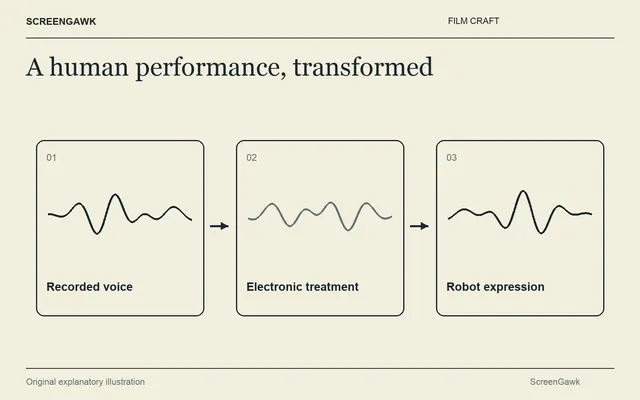
Burtt states the target plainly: a sense of a soul, in sound, that still reads as a machine. Burtt also says audiences would have accepted a human voice laid straight over the robots, so the blend was a creative priority. Disney also credits Burtt with M-O's voice.
Motors, compacting and a cleaning sound
Disney says WALL-E's movement sounds were assigned by speed. The slowest speed, which Disney ties to moments when WALL-E has to be quiet, is an Army hand-cranked generator of the kind used to power a field radio. The fastest is mainly an inertia starter, a part from an antique biplane that was used to start the engine, with additional sounds added as WALL-E gets going. Disney reports that Burtt picked these sounds deliberately for different movements.
The compactor makes a useful comparison with the motors. Disney identifies a recording of compression for compacting, while the movement sounds change with the robot's speed. One choice assigns a recorded action to a similar pictured action; the other distinguishes different speeds of movement. Burtt, as quoted by Disney, argues that real-world sounds lend credibility to a fantastic setting. The compactor and motors show two ways those recordings can be put to work. Disney says M-O's cleaning noise is a recording of Burtt's electric shaver. The same person supplies what M-O says and the sound of what M-O does. It is the sort of efficiency a sound department can enjoy privately.
Recognizing the original shaver is optional. A viewer can follow M-O's cleaning without identifying the object that supplied it. The production detail is valuable for a different reason: it shows how an ordinary recording can be assigned a precise action in an invented world. The same distinction applies to WALL-E's motors. Knowing their origins can sharpen attention to the differences among movements, while the performance still depends on how the sounds are used with the animation.
Wind around the machines
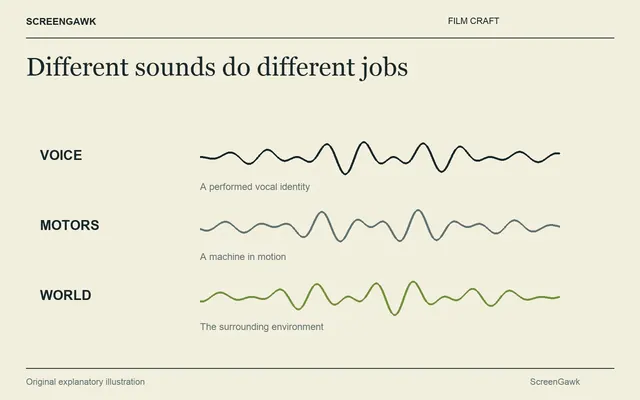
Disney's production account also identifies recordings used for the environment. It says Niagara Falls supplied wind on Earth, while a canvas bag dragged across a carpet became wind inside WALL-E's trailer. These recordings serve a different scale from a motor or a voice: they give the robot surroundings to occupy. The distinction is useful when listening. A sound tied to a moving part belongs to one action; wind can continue around the character while that action starts or stops. The same scene can therefore ask a sound department to suggest both a machine and the space around it.
Trying sounds against a character
Timing mattered too. Burtt describes working early in the production, with sounds followed by animation tests, over roughly three years. Burtt contrasts that overall production period with most film sound work, which Burtt says happens quickly at the end. Separately, Burtt says a director can ask for a motor that sounds cute or for more pathos in a servo, a small motor that moves one part of a machine. Disney reports that Burtt estimated roughly a year of work before the main characters' sounds felt right.
What to listen for
For a listening exercise, ask whether an effect begins with a movement, anticipates it or follows it. Those are different relationships even when the recording stays the same. Listen as well for the way an effect sits beside a voice. Burtt describes trying sounds in animation tests, which gives a concrete example of sound being considered with the pictured action.
For a second look, choose a passage where WALL-E compacts trash. Where music is present, try separating the effect from Thomas Newman's score, credited by D23. Follow the effect once with your attention on the moving parts, then once with your attention on the change the action produces. Ask what the sound adds to the physical event. The exercise is most useful when the mechanical action is easy to distinguish. A dense mix may give a listener less room to isolate it. If that happens, try a quieter passage with a clearly visible start or stop and ask whether your attention settles on the movement or the accompanying sound first.
A voice, a movement and the surrounding wind give the listener different things to follow. Choosing one for a moment can make a familiar robot performance less uniform. Does a change of speed draw your attention more readily than a vocal inflection? Does the environment recede when the robot speaks? The questions leave room for different answers in different passages. They also give a second viewing a modest purpose: hearing how separate jobs share the same scene.