ScreenGawk
How 1917 Built the Feeling of One Continuous Camera Journey
Prefer ScreenGawk on GoogleSee more of our stories in your results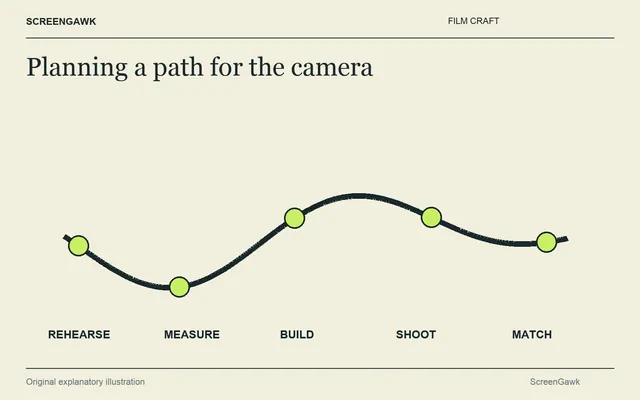
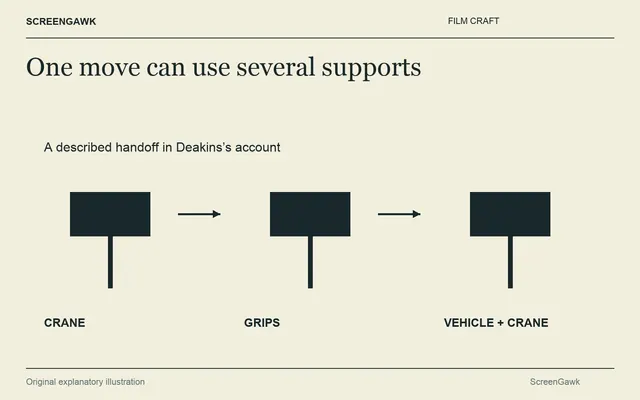
In Deakins's account, two grips in British soldier costume walk backward carrying a camera bar while an actor moves in front of the lens. Roger Deakins, cinematographer on 1917, describes that moment in an American Cinematographer interview dated January 13, 2020. The bar starts on a 50-foot Technocrane, a telescoping camera crane, and the camera dips into a trench and rises with the actor, George MacKay. Two grips lift the bar off the crane and walk it backward, then hook it onto a 22-foot Technocrane on a tracking vehicle, which runs more than a quarter of a mile as the actor sprints through a developing battle. The costumes let the grips cross the frame and read as part of the action.
Deakins says the one-shot note at the top of the script prompted skepticism at first, a worry about gimmickry, until the script showed what Sam Mendes intended: an immersive film that stays with the soldiers every step. Universal's synopsis describes Schofield and Blake as two British soldiers who must cross enemy territory to deliver a message in the First World War, a fictional mission that gives the camera a destination.
Handoffs and blends are different joins
A handoff is a continuous camera move: the camera changes hands and machines within one take, so it is not an edit. The film's other joins are different. Deakins describes combining separately filmed moments with deliberate blends, so the continuous look is constructed, not one uninterrupted recording. Deakins says the team spent a lot of time considering how to make those blends and rehearsing them on set, and that playback helped match an actor's position and the speed of the camera move on the two sides of each one. James Ellis Deakins, the digital-workflow consultant, says the dailies, the footage reviewed after each shooting day, were checked for continuity of look across shots. Deakins does not say where the blends fall.
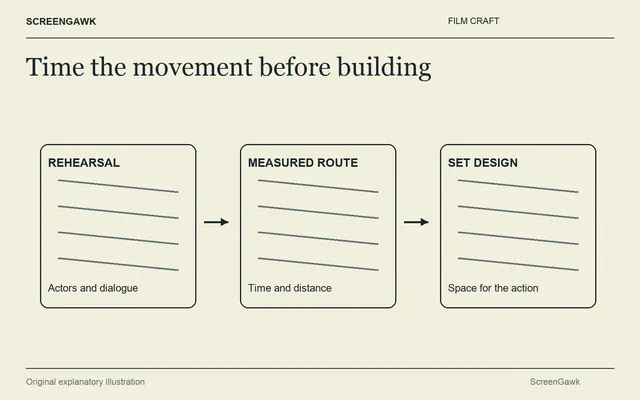
Timing the trench before building it
Deakins says nothing could be designed or built until the team decided what to show the audience and where the camera would be. When a soldier walks, is the camera behind or leading? After a rough storyboard, they rehearsed with the actors at Bovingdon without a set. They marked out a trench line, had MacKay and Dean-Charles Chapman walk it, ran dialogue with stand-ins, and worked out how long the trench needed to be. A point-and-shoot camera mimicking the large-format frame recorded another rehearsal, and only then did production designer Dennis Gassner's crew begin the set. The trench's length came from how long the scene takes to play. Nobody had to guess how far a conversation travels.
Letting the sky set the schedule
Deakins says the heavy day-exterior work made cloud cover key to matching the footage, and because the camera often made 360-degree moves, there was nowhere to place lights. The shoot ran April 1 to mid-July. Deakins had worried about a repeat of the previous year's months of clear U.K. skies, but says it turned out quite cloudy. When the sun came out, the crew rehearsed, and when clouds returned, they shot. Often a short window of cloud meant judging whether it would last, and Deakins describes operating with one eye on the shot and the other on the sky.
Night needed a different answer. For the burning-church exterior on the Shepperton backlot, Deakins describes a six-tier lighting rig about 50 feet tall, later replaced visually with a computer-generated church. The flames and a few flares were the only sources, and the rig had to cover 360 degrees because the camera moved all around the town square. A programmed dimmer pattern, with dimmer-board operator Steve Mathie adjusting levels, brought light down when the camera looked toward the rig and up as it hooked around with the actors.
Choosing rigs for the movement
Deakins says the team tested nearly everything. A wire-cam and a rail-mounted remote rig felt disconnected from the actor, and a stabilized backpack rig limited them to one angle. Steadicam operator Pete Cavaciuti then suggested a rig around the Stabileye, a stabilized system, which became the Dragonfly. Deakins found it the most stable way to get fast movement in trenches: Cavaciuti could run down a trench with the camera pointing backward, reach a corner and pan the whole body into exactly the right place. The team also used Arri's Trinity, a stabilized rig that arms up and down about 6 feet, in and outside the trenches. The rigs were chosen for human movement, and each asked the operator's body, not only the lens, to hit the mark.
No reverse angle to cut to
Deakins says the team always wanted to feel connected to the characters. With no option to cut to a reaction, any reaction they wanted had to be justified by a move, with the best starting place found so it could be built into the choreography of the action. A reverse angle, the shot from the opposite side that shows a listener's face, is what an editor normally reaches for. Here the camera has to travel there, and the listener has to be where it arrives.
Deakins also marks a limit. In preparation, the team looked at Son of Saul, which Deakins calls inspirational. He says it taught them not to linger on an actor's back unless something significant was happening in front. A camera's movement does not by itself decide what deserves attention. Deakins says one-shot filmmaking would not suit every film, or even many, and that for 1917 it seemed perfect.
Two focal lengths, not one
Lens choice follows the same logic. Asked whether a one-shot film used one focal length, Deakins answered that it used two: a 40mm Signature Prime for nearly everything, and a slightly wider 35mm in a couple of interiors, including tunnels and bunkers, to accentuate the claustrophobic feeling and show more of the walls. Deakins says the change is hard to notice in transitions because the camera moves inside at those moments.
If you have seen 1917 and can return to the bunker orders scene, try watching it once for the light. Deakins says the stand-in lamps were programmed to pulse slowly like a flame and adjusted individually as the camera moved. What changes in the light near a face or on a wall as the view travels? If the changes are too subtle to follow, set that exercise aside. For a different pass, give your attention to whoever is listening. Does the moving view change which response you register first? The answer may vary between viewers. The scene gives a familiar exchange two possible points of interest: the light around the figures and the faces receiving the orders.