ScreenGawk
How Disney’s Multiplane Camera Gave Painted Scenes Their Depth
Prefer ScreenGawk on GoogleSee more of our stories in your results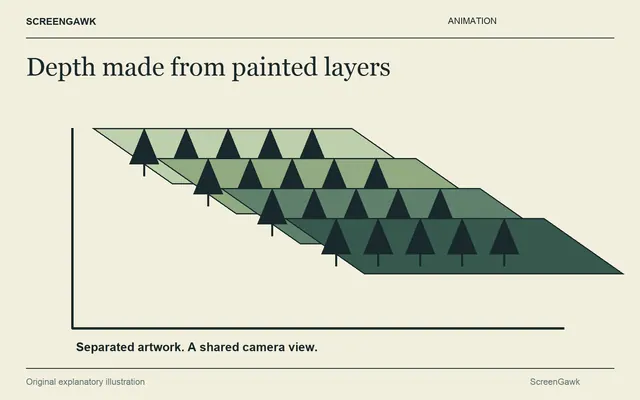
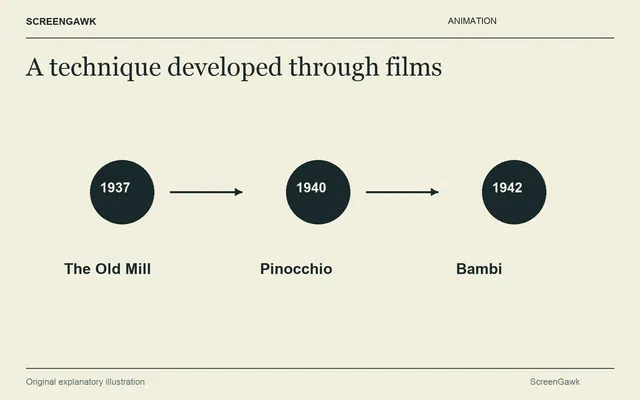
A multiplane camera photographs painted artwork on separate levels. Moving those levels independently can suggest travel through space rather than a slide across one flat picture. The Walt Disney Family Museum dates Disney's camera to 1937 and The Old Mill, a Silly Symphony short. A Disneyland Paris news post published for International Animation Day on 28 October 2026 points back to that same film. Its later example is the forest that opens Bambi in 1942. The familiar feature-film forest therefore followed the short by five years. The vertical Disney stand was one arrangement of the layered-artwork principle; other arrangements also belong to its history.
What the studio was trying to fix
The museum starts the clock earlier. It says 1937 came 17 years after Walt Disney first began experimenting with animation on a flat camera table, and a museum text panel quotes Walt Disney on the problem: "I felt like I had to get a certain feeling of depth; I couldn't just have flatness." Disneyland Paris describes the same starting point from the studio's side, saying animated characters were then mostly moving against flat backgrounds. That is the studio describing its own situation, not a survey of every other studio's practice.
What the glass levels did
The museum describes the hardware. The Multiplane Camera crane stood 12 feet tall and was designed to shoot downward at five levels of foreground and background art, painted in oils on glass. The detail that matters most is control: Walt Disney's artists could set how quickly or slowly each level moved toward or away from the lens, and Walt Disney recalled artists panning over rooftops, down streets and around corners. D23 gives the shorter definition, layers of backgrounds painted on glass. A 12-foot crane is a great deal of apparatus to deliver a rooftop, and the studio evidently thought the rooftop worth it.
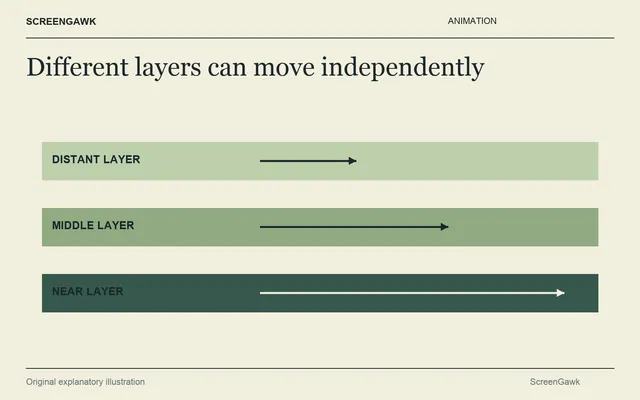
Steven Vagnini of the Walt Disney Archives, quoted in the Disneyland Paris post, says the camera turned layers of painted glass into seemingly dimensional environments and created the impression of moving through the animated world. The museum places the movement in the art levels relative to the lens, while Vagnini describes what the viewer feels.
The museum describes five levels of artwork for the apparatus it presents. D23 says the vertical stand could hold up to six background layers. The figures may refer to different measures: the working levels in one described apparatus and a maximum capacity. They are not interchangeable specifications.
Three sheets, three speeds
Consider a purely hypothetical case, not a scene from any film. A fence, a line of trees and a distant hill are each painted on a separate clear sheet and stacked at different heights below a camera. Because the museum says the speed of each level toward or away from the lens could be set separately, the fence can be given one rate, the trees another and the hill a third. Painted together on one surface, the same three things would have to move as one. That difference is the principle in small, and it offers a way to imagine how separated artwork can differ from one painted surface.
From a short to the features
Disneyland Paris says The Old Mill won the Academy Award for Best Cartoon Short Subject in 1938, and that Walt Disney and the studio's teams received a technical award from the Academy that year for the innovation. The museum says the camera's creators were honored with a special scientific and technical award on the same day Walt Disney won for the short.
The features followed the debut, and Disneyland Paris names them: Snow White and the Seven Dwarfs (1937), Pinocchio (1940), Fantasia (1940) and Bambi (1942). For Pinocchio it points to camera movements through the layered streets of Geppetto's village, and it calls the Bambi opening one of the most iconic examples of the process. D23 says the camera was used most effectively in the features of the 1940s. Those are Disney's own characterizations, a useful guide to where the technique was meant to be seen. Disneyland Paris specifically credits layers of vegetation with giving the Bambi forest depth.
Who gets the credit
The museum attributes the camera to Walt Disney and dates its invention at the studio to 1937. D23 credits Disney staff members working under William Garity. Disneyland Paris describes development by the studio's technical teams. D23's team credit adds a useful distinction to Walt Disney's quoted aim of finding depth: the desired effect and the engineering work are different parts of the history.
D23 says Ub Iwerks, who had left the Disney studio several years earlier, built a horizontal version of a multiplane camera at a studio of his own at about the same time. The term describes a principle, with artwork divided into layers. Disney's vertical stand was one particular arrangement of that principle.
A tall rig and its digital successor
The physical arrangement called for a 12-foot crane, glass artwork and control over the separate levels. That is a substantial apparatus for an effect that should feel effortless on screen. Disneyland Paris says digital techniques gradually supplanted the camera, and D23 names Oliver & Company as the last film to shoot multiplane scenes on it.
Disneyland Paris says the principles of layering images and creating depth continue to inspire modern animation techniques and visual effects. A vertical crane and painted glass are one historical way to give separate images their own positions and movements. The same broad visual question remains available to an animator using different tools: how should the parts of an environment relate as the view changes?
For a second look at Bambi's opening, follow the vegetation nearest the apparent camera position, then give a more distant part of the forest your attention. Ask what makes the space seem to extend beyond one painted surface. That viewing cannot reconstruct the setup of an individual shot. It can put Disney's named example beside the principle illustrated by separate layers. The dates add a different perspective: the 1942 forest followed The Old Mill by five years, and the 1938 Academy honors by four. A familiar feature-film effect had a history in a short before it became part of the later features.