ScreenGawk
Three Game Composers Explain the Work Behind the Music
Prefer ScreenGawk on GoogleSee more of our stories in your results
In Nintendo's Iwata Asks interview marking the 25th anniversary of Super Mario Bros., Koji Kondo and Shigeru Miyamoto trace how the game's music was fitted into a machine with little room to spare. A conversation marking Final Fantasy XI's 22nd year of service has Nobuo Uematsu, Kumi Tanioka and Naoshi Mizuta describing a score split three ways. A Square Enix interview announcing the April 9, 2025 Super Mario RPG soundtrack has Yoko Shimomura looking back at a 1996 job through the 2023 remake.
A name can be easier to remember than the conditions of a job. Kondo reshaped music around a character's movement. Uematsu shared a large score with colleagues. Shimomura returned to a piece after the hardware that shaped it had gone. Each job offered a different problem to solve, even when the finished music carried a familiar composer's name.
Kondo and the rhythm of a jump
Reading the original specifications, interviewer Satoru Iwata names the Super Mario Bros. moods attached to different places: a fun feel above ground, something a little dark underground, bubbly sounds underwater. Kondo says the underwater piece came first because that picture was easy to imagine. The Ground Theme, which Iwata introduces as the tune people may think of first, took two attempts.
The first Ground Theme matched the blue sky and greenery, Kondo says, but not the rhythm of Mario running and jumping, and colleagues said it did not feel right. Miyamoto recalls saying something was off, and that the next version was settled on right away. Kondo wrote that version after playing the prototype and says it stayed as it was. The lesson Kondo draws is practical: playing the game early allowed the music to be matched to its rhythms.
Miyamoto supplies the technical reason sound was in the prototype at all. Sound added late could overload the CPU, Miyamoto says, so the team put in temporary sound early. Kondo describes a second limit on the effects side: one sound serves for Mario shrinking and for entering pipes, and another for stomping enemies and swimming. Kondo's summary is short: it was all to save memory.
Uematsu and a score shared three ways
Uematsu's problem was workload. Uematsu says Final Fantasy XI had to be developed in parallel with Final Fantasy X, that writing the music for both alone was not possible, and that a three-person team with Tanioka and Mizuta was the result. Uematsu adds a motive concerning colleagues' careers: wanting everyone on the sound team at Square, as the company was then called, to be involved in Final Fantasy, which Uematsu thought would help their careers. Uematsu calls it, with a laugh, a kind of parental instinct.
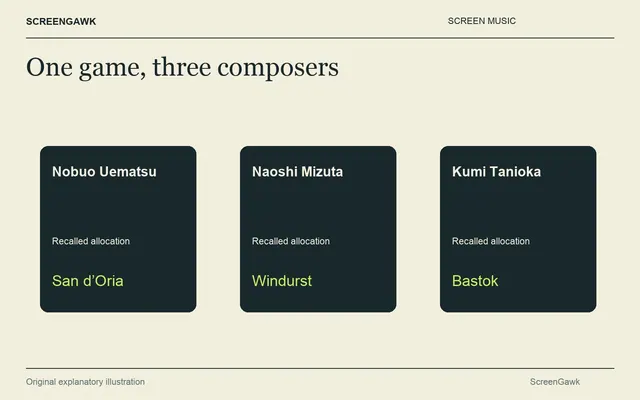
The three then divided the work, and their memories differ in emphasis. Tanioka recalls looking over the requested songs and claiming pieces one at a time, except the final boss theme, which was avoided and left undecided until the end. Tanioka ended up with that one, having never written a proper final boss theme. Mizuta remembers a different first step: three countries, three composers, with Uematsu on San d'Oria, Mizuta on Windurst and Tanioka on Bastok.
Mizuta offers the country split as a feeling rather than a certainty. Tanioka, hearing Mizuta recall the three of them standing in a hallway over the song list, allows that Mizuta might be right. Their memories differ about the initial division of work. Neither is a track list, and Uematsu did not compose all of the game's music. Uematsu adds that on Final Fantasy X tasks were assigned to team members constantly, but does not recall doing that on Final Fantasy XI.
Shimomura and the puzzle of 1996
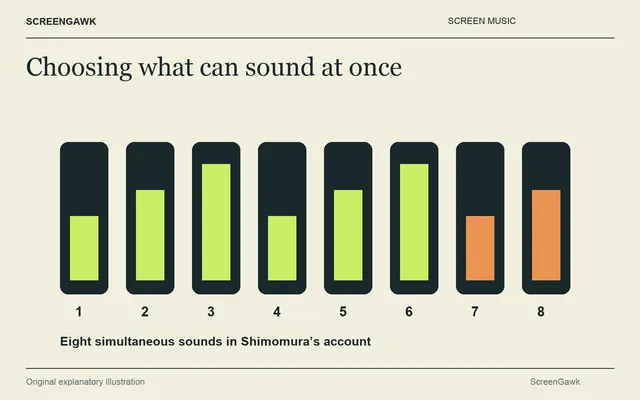
Shimomura's constraint was arithmetic. Of the original Super Mario RPG on the Super Nintendo Entertainment System, or SNES, Shimomura says the work felt like solving a puzzle: memory limits, a ceiling of eight simultaneous sounds and a limited number of instrument channels. Adding an effect meant sacrificing something else. The ending's piano was one hard case. A realistic piano takes a lot of memory, Shimomura says, and other instruments wanted memory too, so the allocation had to be adjusted carefully, with Shimomura repeating, "This is a piano!" as the work went on.
The ending's fireworks show the puzzle at work. Shimomura was told sound effects were no longer needed in the ending, so every track went to music and the instrument bank, a set of instrument sounds, was packed full, partly with memory meant for effects. Then came a request for a fireworks effect. With no room left, Shimomura switched during a brief silence to a different bank that held the effect, played the fireworks, and switched back. The ending was a grand medley, and Shimomura wanted as many instruments as possible. It is a tidy answer to a request that arrived after the budget was spent.
The return came decades later. Shimomura says being asked to write music for Super Mario RPG again was a surprise and a pleasure. The Nintendo Switch remake came out in 2023. The Square Enix interview announces April 9, 2025 as the soundtrack's release date. With the old limits gone, the composer says the desired piano sound became possible. Yet the SNES sound retained its appeal, and Shimomura calls the two soundtracks equally valid interpretations rather than treating the newer one as a replacement.
Attachment to the original complicated the early remake arrangements, according to Shimomura. Shimomura says the early remake arrangements felt overly retro or cluttered because Shimomura was so attached to the original and focused on recreating everyone's memories, and that simply swapping in real instruments did not always work. What changed the approach, Shimomura says, was working the way modern game music is made, deciding how much to record from each track's scale, rather than imitating SNES sounds.
For a move from games to film, ScreenGawk's collection of movie scores by famous musicians follows another set of composers. For a small listening comparison within Super Mario RPG, the ending gives a more specific place to begin. Shimomura names its medley "Fun Parade, Cheerful Parade / There Goes the Parade..." A listener with access to both soundtrack versions could follow the piano part, keeping in mind the memory problem the composer described and the later freedom to choose a different sound. That comparison suits someone who can hear both versions; it does not require declaring a winner. What difference does the changed piano make to the texture of that part?