ScreenGawk
How Blade Runner 2049 Built Its Orange Las Vegas
Prefer ScreenGawk on GoogleSee more of our stories in your results
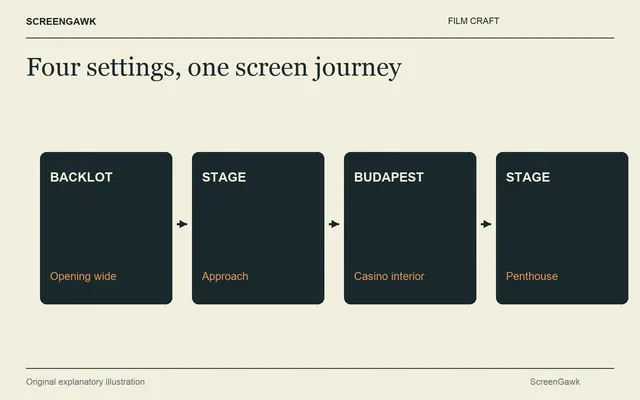
Roger Deakins's interview with American Cinematographer, dated March 6, 2018, documents how Blade Runner 2049 was photographed, and his answer about Las Vegas is a short inventory of places. The sequence opens on a studio backlot, moves to a stage for the approach to the casino, goes inside a former stock exchange in Budapest, and ends his account in Deckard's penthouse, back on a stage. Deakins says he and director Denis Villeneuve wanted to do as much as possible in camera. The orange that links those four places came from several kinds of work, and the useful question is which kind did which job.
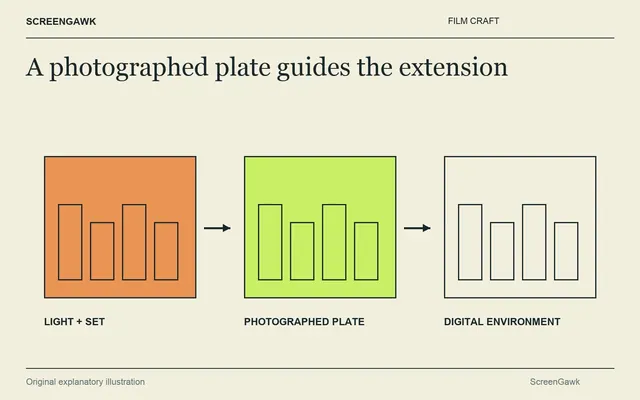
Framestore, one of the visual-effects studios on the film, describes the other side of the work on its own project page. Its art department drew concepts of a deserted Las Vegas based on the work of Syd Mead, the team built the city in computer graphics, and supervisor Richard Hoover says Deakins dictated the look by how he shot the plates on stage, meaning the photographed footage that effects artists build on.
The backlot and the stage approach
The first shot is the easiest to misfile. Deakins says the wide view of K looking at the distant city was shot on a studio backlot, and he calls that city CG. What the camera saw directly was photographed; the skyline was computer-made. He does not say who built it.
Closer to the casino, color began with lamps and a lens filter. The exterior moved onto a stage, where Deakins describes a rig of space lights overhead, left ungelled for this scene, and Maxi-Brutes at the sides covered in green gel to put a yellow highlight in the sky. A gel is a colored sheet that tints light. In front of the lens he used a filter pack that Tiffen made based on two lighting gels he had chosen, Lee 790 Moroccan Pink and 105 Orange, which gave the picture an overall red look.
The rig had a second job, the sort of economy a production schedule rewards. Deakins says the same stage and overhead lights were meant for a daytime snow exterior, and because both scenes involved CGI, a gray cyclorama (a curved backdrop wrapping the stage) served both. To vary the approach to the hotel, crews wheeled sections of large statues in and out, reset the stage in a new configuration after a quick turnaround, and filled the air with a good deal of smoke. One stage became several apparent places, at the cost of some very large furniture.
The Budapest exchange
When K steps inside, the film goes to a real building. Deakins calls the former stock exchange in Budapest the production's largest practical location, meaning a genuine structure instead of a built set, and he shot on at least three of its floors. The building was lit from outside, and its windows were gelled and diffused to match the red look. Different windows received different mixes. Moroccan Pink with Orange went on some lower windows, while a Golden Amber went on the main skylight and some upper windows, so that the light would feel less heavy higher in the building.
This is color placed in the building itself, falling on whatever the camera pointed at, which is a different thing from tinting a finished picture. A grade, the adjustment of color after shooting, was part of the process too, and Deakins sat in on the final one at EFilm. The window treatments, though, show decisions made group by group before anything was photographed.
The penthouse and its painted city
The penthouse returns to a stage and brings in the painted backing. Outside its window stood a large painting of the Vegas cityscape in gray tones, lit by lamps gelled with alternating light and heavy amber. Deakins says there was talk of making that backing a greenscreen, a flat green surface later replaced with picture, and that he argued against it: in his judgment nothing real would reflect onto the set, and the result would not be believable.
The backing was not left alone. For most shots on it, Deakins says, visual-effects supervisor John Nelson's team made a few buildings look more three-dimensional and more detailed, while other shots use the original painting. A painted object, amber lighting and a digital finish could therefore share one frame.
What the stage plates had to carry
Framestore's account explains what the stage photography handed to the computer city. Hoover says Deakins also supplied one photograph as a reference for how the sun should appear through the sandstorm atmosphere. The studio, Deakins and Villeneuve often discussed how far into the distance viewers should be able to see, a narrow balance, in Hoover's account, between giving shots depth and letting the audience catch only a hint of what lay beyond.
The city itself was not finished to a single standard. Supervisor Adrien Saint Girons says each building went through three phases: blocking, a rough first form, then more overall detail, then a full finish only if a close-up required it. Villeneuve wanted the space kept relatively simple and empty, and the studio balanced that against a sense that the place had once been a busy center of entertainment. Not every building, in other words, holds identical detail.
Matching the camera’s view
Framestore identifies work at a different scale from building the city. Compositing supervisor Luigi Santoro worked on rendering shots with lens distortion. A lens can change the shape of a photographed view, so combining photographed and computer-made elements involves more than choosing the right buildings. This is a separate task from the environmental design Saint Girons describes. The departments share a finished image even when their problems concern different features of it.
A sandstorm reference for the Vegas environments
Framestore names the 2009 Sydney sandstorm as a visual reference for the Vegas environments. The resemblance offered a starting point for an invented place, rather than a requirement to reproduce Las Vegas as it looks in ordinary weather. It also helps explain why the studio describes the strong orange atmosphere as a major challenge. The familiar work of constructing a city had to serve an unfamiliar degree of color and obscurity. The buildings were part of a place that the audience would see through that atmosphere, not an architectural display in clear daylight.
On a rewatch, compare the light falling on a surface near K with the city visible beyond him. The stage photography already carried colored light and smoke; the computer-made city extended the setting to match. The penthouse offers a more specific comparison. Its painted backing supplied something physical outside the window, and Nelson's team enhanced some buildings while leaving other shots with the original painting. Deakins does not identify every altered shot, so the exercise is to follow how the room and its distant view work together rather than assign each visible building to a technique.